There is something almost everyone does at work, yet almost no one admits to doing: accepting stress as inevitable.
We normalize it. We carry it. We organize our days around it, without really naming it. And yet, its consequences are anything but silent.
In Belgium, the figures are striking. According to a study by the Mutualités Libres based on data from 2.3 million members between 2018 and 2024, burnout has nearly doubled in six years, with a 94% increase. In 2023, according to Idewe’s 2024 survey on psychosocial risks at work in Belgium, around one in six Belgian workers showed a high risk of burnout, compared to one in ten in 2014—an increase of nearly 40% over a decade.
Stress is not an individual weakness. It is a collective warning signal.
What AI can change in stress management
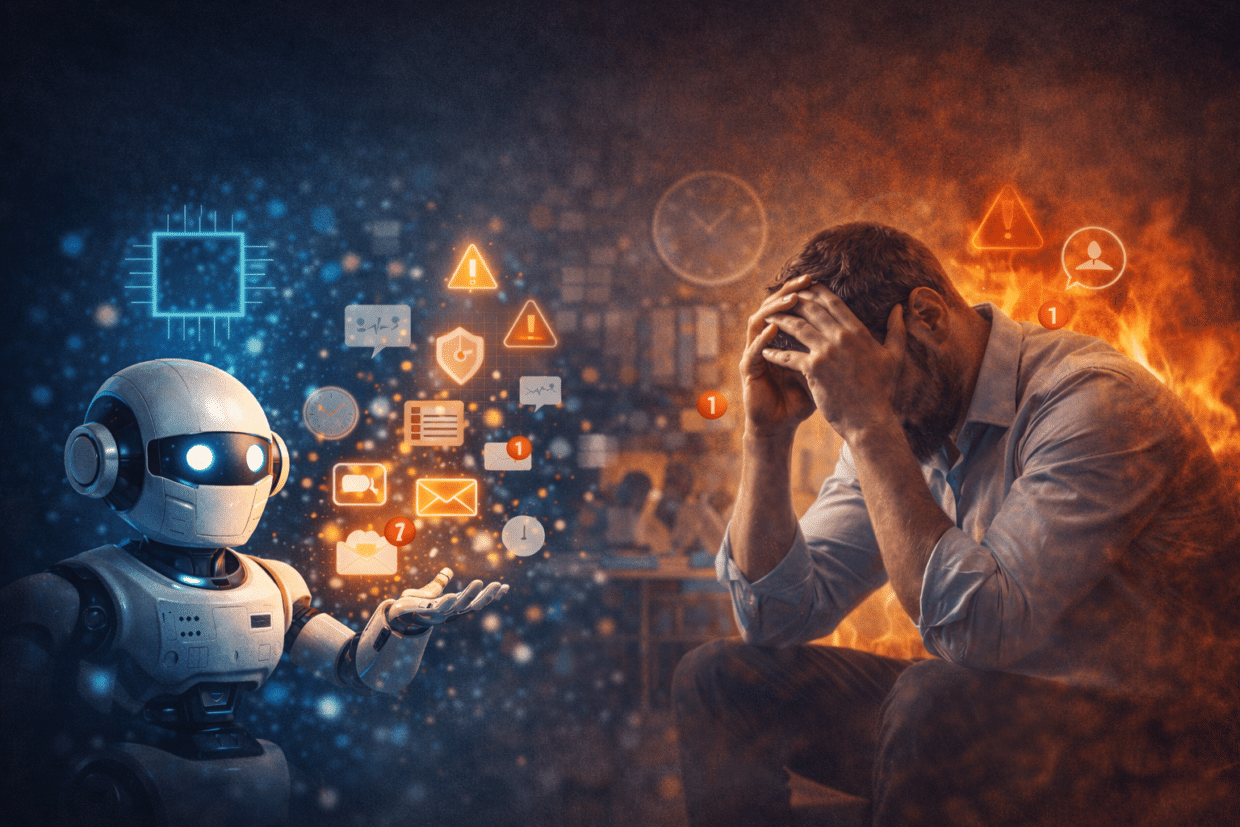
Artificial intelligence does not solve stress, but it can reduce some of its causes.
Concretely, it can:
- Lighten cognitive load: delegating repetitive tasks to AI tools frees up mental energy for what truly matters;
- Better anticipate workload peaks: some tools analyze calendars and task distribution to flag overloads before they occur;
- Facilitate access to support: AI-powered well-being platforms help employees identify their stress levels and access relevant resources;
- Improve managerial monitoring: team analytics tools can detect weak signals—absenteeism, productivity drops, isolation—before situations escalate.
These contributions are real. But they address symptoms, not root causes.
Marc, or the manager who kept running
Marc is a sales director in a distribution company. Organized and ambitious, he has always handled pressure well. When his company deployed AI tools to automate reporting and sales forecasting, he saw his administrative workload significantly decrease.
Yet six months later, he was exhausted.
It wasn’t the work itself that drained him. It was the way he responded to it. The constant pursuit of perfection, the inability to truly delegate, the deep belief that he had to control everything. AI had freed up his time… which he immediately filled with new responsibilities he assigned to himself.
What AI will never do for you
Managing stress starts with self-awareness. And this is where tools stop. They cannot:
- Identify your personal triggers: what truly puts you under pressure? Workload, others’ expectations, uncertainty, fear of failure?
- Change your automatic responses: patterns of overcontrol, procrastination, or hyperactivity are deep mechanisms—not software bugs;
- Build your inner resilience: resilience develops through experience, through your relationship with yourself and others;
- Help you accept discomfort: tolerating uncertainty, setting boundaries, saying no without guilt—these skills cannot be programmed.
Stress is first and foremost a human response to a perceived threatening environment. Managing it sustainably means learning to change that perception, not just the environment.
Acting on stress: a strategic priority for organizations
Organizations that treat well-being as a “nice to have” pay a high price. Long-term absences, turnover, decreased performance in chronically stressed teams—all of this has a very real cost.
Investing in stress management means investing in the human sustainability of your organization. It involves training managers to detect warning signals, creating spaces for dialogue and regulation, and working on individual beliefs and behaviors.
This is exactly what our training offers: supporting your employees in developing a true understanding of stress—what drives them, what drains them, and how to build sustainable inner resources.
Because in an AI-augmented environment, sustainable performance starts with the health of the people who bring your organization to life.
Interested in learning more? Discover our “stress management” training programs.