Belgium stands out. According to Remote’s Global Life-Work Balance Index 2025, it ranks third worldwide for work-life balance, with an average 35-hour workweek, reformed sick leave policies, and stronger legal protections.
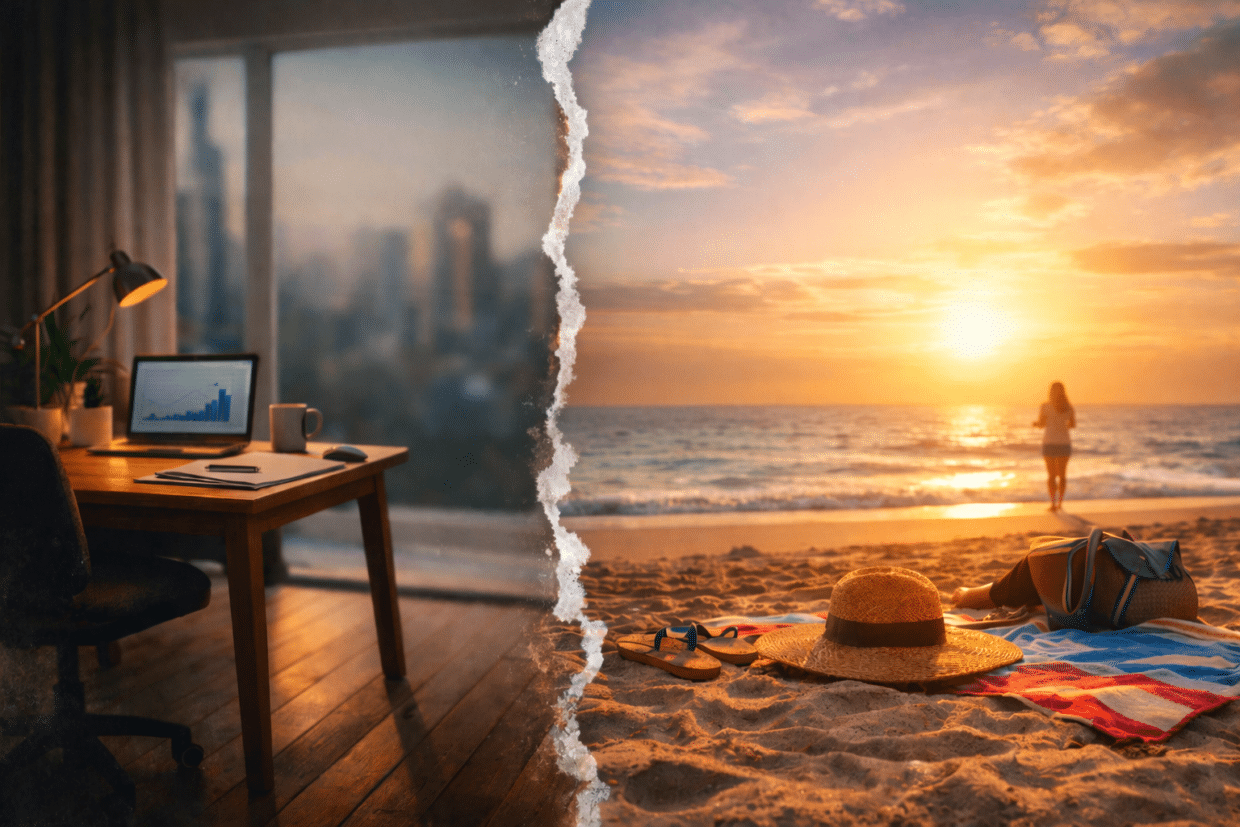
And yet, in reality, this balance remains fragile. An SD Worx study shows that 79% of Belgian employees believe remote work improves their work-life balance. But the same remote work that frees can also invade: boundaries blur, evenings stretch onto screens, and constant availability becomes an unspoken norm.
The tool that liberates can also bind. That is the central paradox of our time.
What AI changes in managing this balance
Artificial intelligence offers concrete levers to better manage the boundary between professional and personal life:
- Automate to free real time: less time spent on repetitive tasks means potentially more time for yourself, your family, your projects;
- Plan intelligently: AI assistants analyze your calendar and suggest protected time slots, free from meetings or interruptions;
- Reduce evening mental load: by summarizing the essentials of the day, some tools help you mentally “close” work before leaving;
- Make work more predictable: better anticipation of workload reduces last-minute surprises that spill into personal time.
These gains are real. But they require one condition: consciously deciding to use them for yourself—not to work more.
Laure, or the trap of permanent flexibility
Laure is a senior legal advisor in a consulting firm. Passionate and rigorous, she has carefully organized her life since having two young children: three days of remote work per week, AI tools for research and drafting, a voice assistant to capture ideas in the evening.
In theory, her life is perfectly structured. In practice, she no longer has working hours.
The problem? Flexibility gave her the illusion of control while removing the natural markers that once defined her day. Previously, leaving the office marked a clear boundary. Today, with all her tools, work is everywhere, and therefore nowhere clearly contained.
Laure realized she had no disconnection ritual. No symbolic moment telling her: it’s over for today. AI had optimized her working time. No one had helped her protect her life time.
What AI will never do for you
Work-life balance is not a matter of organization. It is a matter of values and internal boundaries. AI cannot:
- Decide what truly matters to you: family, health, leisure, rest—these priorities are chosen, not calculated;
- Help you set relational boundaries: telling a client or a manager that you are not available on weekends requires courage, not an algorithm;
- Manage the guilt that arises when you “let go” of work;
- Replenish your resources: creativity, energy, and joy are not restored in a dashboard—they are found in rest, play, and relationships.
A sustainable balance cannot be configured. It must be built, protected, and regularly reassessed—with full awareness.
Regaining balance: a skill you can learn
In a world where tools make work accessible everywhere, at any time, protecting your personal space becomes a deliberate act. It is not a luxury. It is a condition for sustainable performance, and for health.
It requires clarity about your values, the ability to set healthy boundaries, and the creation of concrete rituals that separate life domains. These are skills that can be learned and strengthened.
Our training programs support exactly this process: helping professionals regain control over their time, energy, and life, without guilt and with practical tools. Because you cannot work well over the long term if you don’t also know how to stop.
Want to better balance your life? Discover our training “Disconnect and free yourself: master the right to disconnect with our tools”.
Unplug and Free Yourself: Master the Right to Disconnect with Your Tools