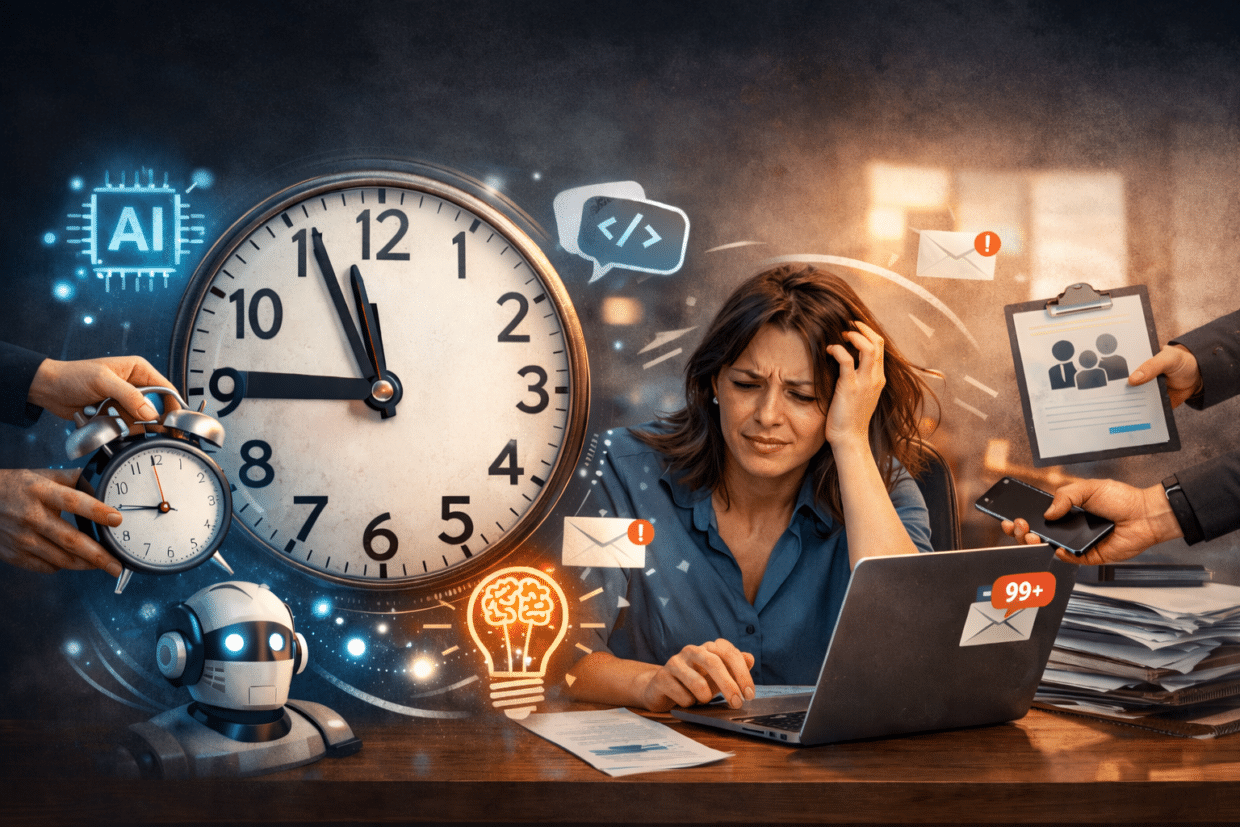
You have probably already used—or considered using—an AI tool to save time. Summarizing a document in thirty seconds, generating a first draft of an email, automating a weekly report. Promise delivered: the time savings are real.
And yet, one question remains: why, despite all these tools, do you still feel like you’re running out of time?
The answer is uncomfortable. It’s not a tool problem. It’s a behavior problem.
A painful reality: we waste time even when we have it
The numbers are staggering. According to a 2024 Asana study, French workers spend an average of 9.1 hours per week in unproductive meetings—the highest among the countries analyzed. According to The Economist, knowledge workers lose an average of 127 hours per year regaining focus after interruptions from meetings and emails.
In other words: we don’t lack time. We let it slip away.
And it’s not for lack of tools. It’s for lack of awareness of our own habits.
What AI really changes in time management
Artificial intelligence brings concrete and measurable gains. Used wisely, it can:
- Automate repetitive tasks: meeting notes, summaries, formatting, recurring reports;
- Prioritize information: sorting emails, flagging urgencies, filtering noise;
- Facilitate planning: some AI tools analyze your calendar and suggest deep work slots, away from interruptions;
- Reduce preparation workload: briefings, preliminary research, industry monitoring.
The result? Hours recovered. Time freed up for what really matters: thinking, deciding, interacting.
But here’s the trap. Most professionals immediately fill that freed time, with more meetings, more emails, more requests. AI optimizes the container. It does not change behaviors.
Sophie, or the paradox of the well-equipped executive
Sophie is a marketing director in a growing SME. Organized and ambitious, she quickly adopted the AI tools available in her company. Her presentations are generated faster. Her data analyses take half the time. On paper, she has recovered nearly five hours per week.
Except Sophie hasn’t really recovered them.
Looking more closely at her calendar, she realized she had simply added five extra hours of meetings. Available, responsive, always reachable—she had become a slave to her own agenda. AI had done its job. Sophie, however, had not changed how she set priorities, said no, or protected her focus time.
It was a coach who asked her the real question: “Why do you find it difficult not to respond immediately?” This wasn’t a question about methods. It was a question about herself.
What AI will never do for you
Time management is, at its core, an emotional and relational skill as much as a methodological one. It involves abilities that AI cannot replicate:
- Saying no: to a colleague, to an unnecessary meeting, to a manufactured urgency;
- Tolerating the discomfort of the unfinished: accepting that not everything will be done in a day;
- Identifying what is truly important – not just urgent;
- Resisting immediate gratification: from messaging, notifications, and the feeling of being indispensable.
These skills fall under self-management: the ability to regulate oneself, to observe one’s behavior, and to act in alignment with true priorities rather than reacting to external stimuli. No algorithm will develop this for you.
The real question: have you changed your habits, or just your tools?
AI is a powerful lever. But a lever is useless if you don’t know how to use it.
Managing your time effectively in an AI-augmented environment starts with self-awareness: your procrastination triggers, your bias toward urgency, your difficulty in setting boundaries. It then requires building rituals, personal rules, and the discipline to stick to them.
This is exactly what our training focuses on: not giving you yet another method, but helping you understand why the methods you already know don’t last over time. Because true time management begins where tools stop.
Interested in learning more? Discover our time management training here.