There are meetings where everyone speaks, but no one truly listens.
Email exchanges that spiral into misunderstandings. Well-crafted feedback that still hurts. Silences that say more than any message ever could. Interpersonal communication lies at the heart of professional life, yet it remains one of the most overlooked skills in organizations.
The numbers are striking. According to a survey conducted by Fierce Inc. among more than 1,400 executives, employees, and trainers, 86% of employees believe that workplace failures are primarily due to a lack of collaboration or ineffective communication. This is not a problem of strategy, budget, or technology. It is a human relationship issue.
What AI concretely brings to communication
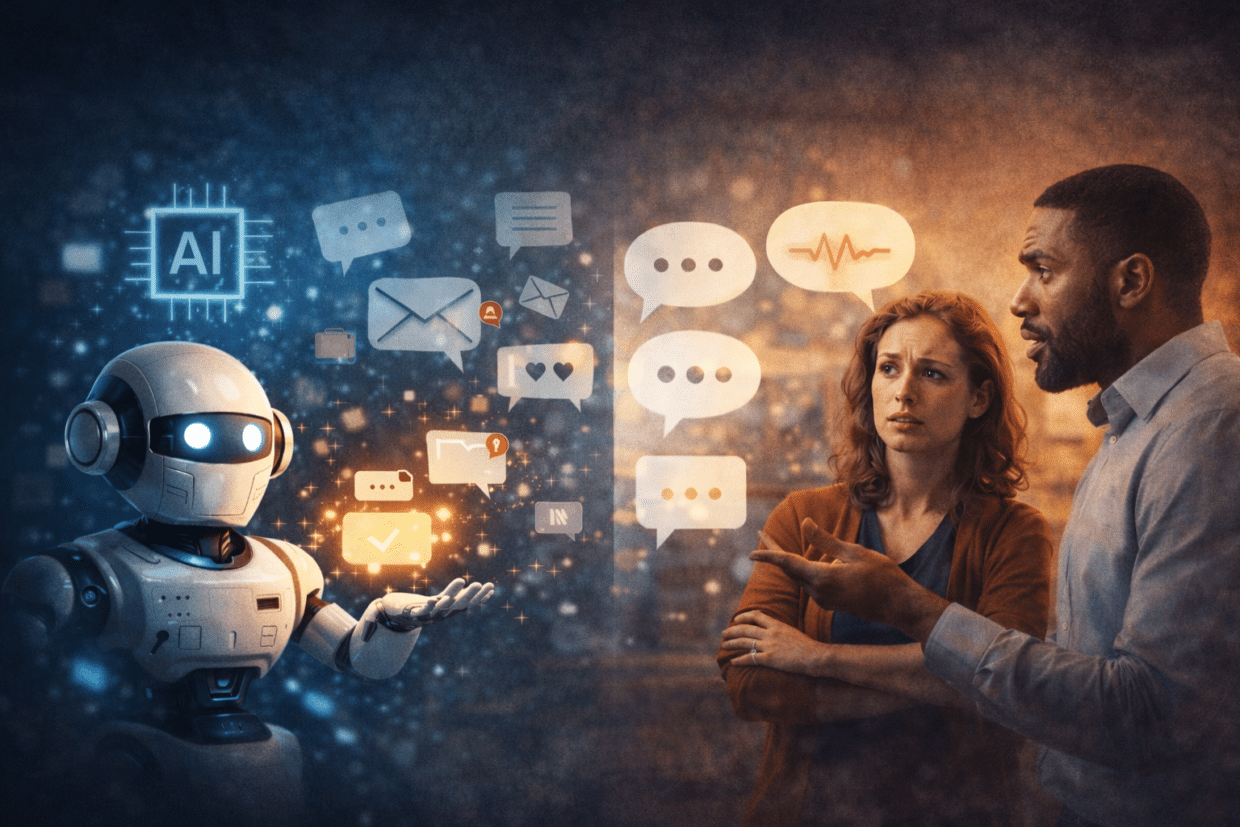
Artificial intelligence is already transforming how we communicate daily—and not just by writing emails faster. Here is what it actually enables:
- Improving clarity in writing: some tools detect ambiguous phrasing, inappropriate tone, or overly long messages before they are even sent;
- Facilitating intercultural communication: real-time translation, tone adaptation based on cultural context, detection of false cognates;
- Analyzing meeting dynamics: some platforms measure speaking time, identify less engaged participants, or flag moments of tension;
- Structuring complex exchanges: automatic summaries, generated action points, and concise reports.
These tools reduce friction. They eliminate part of the misunderstandings caused by poor wording or poorly shared information. This is a real gain.
But human communication is not limited to well-chosen words.
Amina, or the paradox of the silent communicator
Amina is an HR manager in a service company of around 200 employees. Rigorous and educational, she quickly adopted AI tools to improve her internal communications: clearer messages, better-structured newsletters, automated reports.
The result: her writing is impeccable. Her presentations are crystal clear.
Yet, during an internal employee survey, several teams expressed a sense of distance from HR. Too formal. Too polished. As if the messages came from an institution rather than a person.
What the tools had optimized was the form. But what employees were looking for was presence. Listening. Amina’s ability to stay in the discomfort of a difficult conversation without trying to resolve it too quickly.
This realization led her to rethink not her tools, but her posture. To learn to listen without responding immediately. To tolerate silence. To let the relationship take precedence over the message.
What AI will never communicate on your behalf
Interpersonal communication, in its depth, relies on skills that AI cannot simulate:
- Active listening: being fully present to what the other person is saying, without preparing your response at the same time;
- Reading non-verbal cues: detecting hesitation in a voice, tension in a posture, disagreement in a look;
- Real-time adaptation: adjusting tone, pace, and words based on what you perceive from the other person;
- Managing disagreement: daring to name what is difficult, without attacking or avoiding;
- Building trust: that invisible bond developed over time through consistency between what is said and what is done.
These skills cannot be automated. They must be practiced, experienced, and sometimes unlearned before being rebuilt differently.
Communicating better: a strategic skill, not a natural talent
In an increasingly digital workplace, the quality of human relationships becomes a key competitive advantage. Organizations that invest in interpersonal communication are not betting on vague “well-being”—they are investing in collective performance, talent retention, and the ability to navigate tensions without breaking.
The good news: contrary to common belief, effective communication is not about personality. It is a skill. It can be learned, structured, and strengthened.
This is exactly what our training programs offer: practical spaces to experiment, adjust, and develop more accurate, fluid, and human communication, while taking into account the realities of an AI-enhanced work environment. Because in relationships, it is always people who make the difference.
👉 Want to learn more? Discover our training: “Communication & interpersonal skills”.